

About
Science, innovation and leadership judgement.
Organisations today operate through continuous change, increasing complexity and multiple constraints. Markets change. Technology changes. Regulation changes. Customer expectations change. Capital and operating realities create further constraints.
The key strategic issue is often not simply resources or expertise, but how leaders interpret the situation in front of them. Existing assumptions, perspectives and patterns of thinking can limit what leaders see, and therefore limit the possibilities available for judgement, innovation and action.
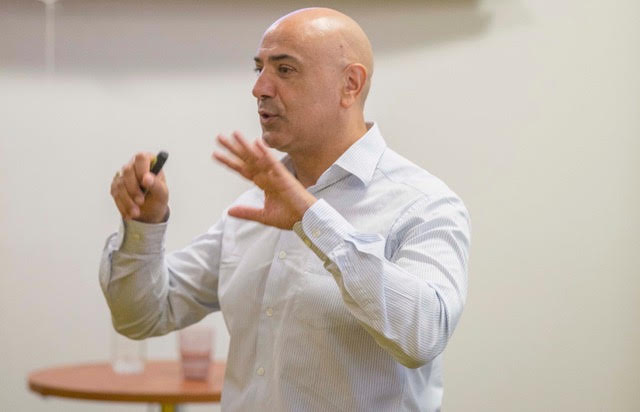
Dr Edward Kachab's work sits at the intersection of scientific thinking, commercial innovation, leadership judgement and organisational capability. It has been shaped across research, technology commercialisation, entrepreneurship and executive development and is applied with executive teams operating in complex, high-consequence and regulated environments.
The focus is on shifting how a situation is seen, so that new thinking can emerge and new possibilities for action open up without requiring external conditions to change first.
Foundational Experience
Behind PARADIGM SHIFT
Technology & Commercialisation
Creating new possibilities through technology development, commercialisation, intellectual property, strategic partnerships, and venture creation.
Innovation & Value Creation
Unlocking and capturing value by recognising opportunities, navigating uncertainty, and creating outcomes under real-world constraints.
Leadership & Judgement
Developing leaders and high-performance teams capable of translating insight into action in complex and demanding environments.
Integration & Organisational Capability
Connecting ideas, disciplines, and perspectives to strengthen organisational capability, adaptability, and long-term performance.
Professional background
Foundational Experience of PARADIGM SHIFT
For more than a decade, I have held a simple belief: Organisations cannot effectively engage with uncertainty, recognise new opportunities, or unlock new value using the same thinking that produced their current results.
Throughout my work in technology development, innovation, entrepreneurship, leadership, and organisational development, I became increasingly interested in one question:
Why do some people and organisations consistently recognise opportunities and create value in changing conditions while others remain constrained by familiar ways of thinking?
As someone whose early training was science, I have always been a keen observer of patterns. One pattern became increasingly difficult to ignore. Many organisations that struggled to adapt were not lacking intelligence, technical expertise, resources, or commitment.
More often, they struggled because new thinking never found its way into their day-to-day operation. The challenge was rarely capability. The challenge was that existing ways of seeing continued to produce existing ways of thinking.
Through years of working in innovation, entrepreneurship, technology commercialisation, and global collaborations, I experienced firsthand how opportunity recognition, new thinking, and value creation were deeply connected.
Over time, this reinforced my belief that sustainable growth and value creation depend less on having more resources and more on developing the capacity to think differently and adapt when conditions change.
Leadership added another dimension to this understanding. As a leader developing high-performance teams, I deliberately introduced practices that encouraged new thinking, challenged assumptions, and expanded what my team believed was possible.
The results were significant and measurable. Teams became more adaptive, more innovative, and more effective at recognising opportunities and solving complex problems.
What became increasingly clear was that the ability to generate new thinking was not a talent possessed by a few individuals. It was a capability that could be deliberately encouraged and strengthened.
One missing piece in the puzzle emerged through my more recent executive advisory work with organisations operating in highly regulated, complex, and high-consequence environments.
These organisations possessed extraordinary technical expertise and highly capable people. Yet they operated under significant operational, commercial, regulatory, and strategic constraints.
What became apparent was that the greater the constraint, the more important new thinking became.
In these environments, competitive advantage could no longer rely solely on technology, expertise, reputation, systems, or resources. It increasingly depended on a leader's ability to recognise opportunities, reinterpret constraints, exercise sound judgement, and unlock new value under changing conditions. That single insight brought everything together.
The principles I had observed through innovation, entrepreneurship, technology development, leadership, and value creation suddenly aligned around a common challenge:
How do organisations develop the capability to consistently generate new thinking under constraint?
Paradigm Shift emerged as the answer to that question. Today, Paradigm Shift helps executive teams strengthen their capability to recognise opportunities, unlock new value, and innovate effectively under constraint and changing business conditions.
Vision
See Differently. Act Effectively. Unlock New Value.
A conversation is the most useful place to begin.
Discuss the challenge your executive team is navigating.